



Built for change, not just ready for it

Change readiness has been the standard for years, and for good reason. Get people prepared, get the plan understood, get the organisation to a state where it can absorb what's coming. It's sound thinking. It's just built for a world where change was still an event — something with a before and an after, that you could get ready for, come through, and then rest.
That world isn't the one we're in. Research from Harvard Business Review in 2023 found that one in three employees experience 15 or more changes a year. Not one transformation. Fifteen. When change is arriving at that pace, "readiness" stops being a state you reach and start relying on. There's no gap between changes long enough to sit in it.
That's not a reason to abandon readiness. It's a reason to build on it. Being built for change takes everything readiness got right — clarity, preparation, alignment — and turns it from something you assess before an initiative into something the organisation carries permanently. Readiness answers "can we handle this change?" Being built for change answers a different question: "can we handle whatever comes next, and the thing after that?"
So the useful question now isn't "are we ready?" — it's "have we built the standing capability for this to just be how we operate?" And when we look at why organisations stall on that question, it's almost never the plan. It's the same six root causes, again and again.
The six things actually getting in the way
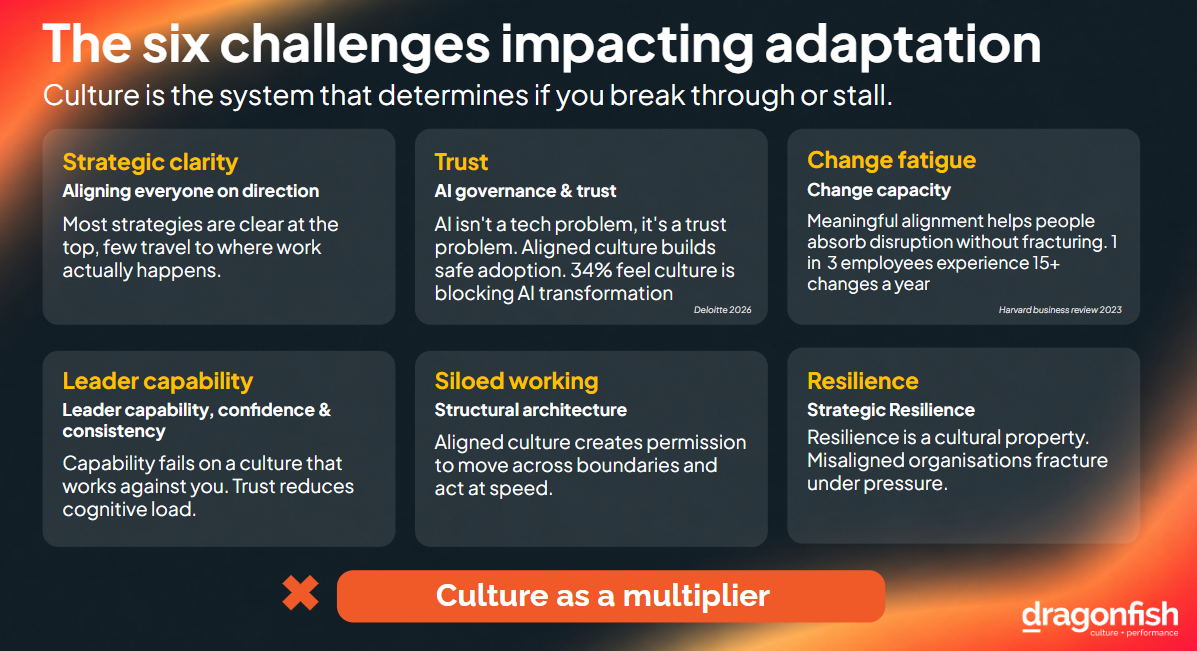
Strategic clarity. Most strategies are clear at the top. Very few travel to where the work actually happens. A clear plan in the boardroom and a confused team on the floor are not the same thing as alignment.
Trust. This shows up sharpest with AI right now. AI isn't a technology problem, it's a trust problem — and a Deloitte 2026 finding puts a number on it: 34% feel culture is blocking AI transformation in their organisation. Aligned culture is what makes new ways of working feel safe to adopt, rather than something to quietly resist.
Change fatigue. Meaningful alignment is what helps people absorb disruption without fracturing. Without it, that HBR statistic — 15-plus changes a year — stops being a number and starts being burnout.
Leader capability. Capability doesn't fail because leaders lack skill. It fails when culture works against them. Trust reduces cognitive load; its absence adds friction to every single decision a leader has to make.
Siloed working. Aligned culture gives people permission to move across boundaries and act at speed. Misaligned culture reinforces the walls between teams, functions and sites — and speed dies at every one of them.
Resilience. Resilience isn't a personality trait some organisations happen to have. It's a cultural property. Misaligned organisations don't bend under pressure. They fracture.
The model: culture as a multiplier
Here's the thing about those six: they're not six separate problems needing six separate fixes. They're symptoms of one underlying condition — whether culture is multiplying your organisation's capability, or dividing it.
Group them, and a simple model falls out:
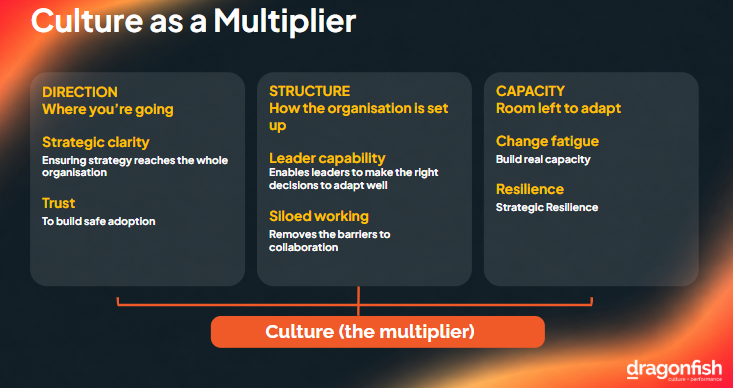
- Direction — strategic clarity and trust. Do people know where you're going, and do they trust the system guiding them there?
- Capacity — change fatigue and resilience. Can people actually absorb what's coming, or is the system already running on empty?
- Structure — leader capability and siloed working. Does how you're organised let people and decisions move, or does it get in the way?
Culture sits at the centre of all three, not as a fourth item on the list, but as the multiplier running through the other three. Aligned culture multiplies clarity, trust, capacity and structural speed all at once. Misaligned culture divides all of them at once — which is exactly why organisations under strain rarely fail on just one front. They fail on several simultaneously, because the same underlying condition was dividing all of them the whole time.
Six questions, asked continuously — not once
Because this isn't a one-off audit, these are questions worth returning to regularly, not answering once and filing away:
- Does our strategy actually reach the point where work happens, or does clarity stop at the top?
- Do people trust the culture and leadership enough to adopt new ways of working — including AI — without quietly resisting?
- How much change fatigue is already in the system, and are we building capacity for it or letting it accumulate?
- Is culture working with our leaders, or against them?
- Can people move across silos at the speed the work now demands?
- If real pressure hit tomorrow, would our culture hold — or fracture?
If the answer to most of these is uncertain, you are not alone. It's actually a good starting point. Culture as a multiplier means the six things above were never separate initiatives to run in parallel. They're one system, and it's worth understanding as one system before you try to fix any single part of it.
If you'd like a clearer, evidence-based view of where that system is multiplying your organisation's capability — and where it's dividing it — get in touch.
More from our journal



.jpg)


