



Leadership & Management Capability
Leaders create conditions where people choose new actions. The choices are voluntary. They’re made by people who see a new landscape, new opportunities and new options. You can’t make people change — but you can create an environment where they choose to.
Why does most leadership development fail to stick?
Most programmes develop the individual. The performance gap lives in the system around them.
Organisations spend billions on leadership development every year. They send leaders on programmes, invest in coaching, roll out competency frameworks. And yet the gap between knowing and doing persists.
The reason is almost always the same. Most leadership development treats leadership as an individual capability problem. It focuses on the person in the room, their skills, their style, their blind spots, and assumes that if you develop enough leaders well enough, the organisation will shift.
That assumption is wrong, or at least, incomplete. Leadership capability isn’t just what a leader knows or how they behave in isolation. It’s how they show up in the system around them. It’s the conditions they create for others. It’s the culture they reinforce every day through the decisions they make, the conversations they have, and the behaviours they tolerate.
The leaders who drive real performance improvement aren’t just skilled individually. They understand their role in the system. They lead themselves, their people, and the organisation around them, simultaneously and deliberately. That’s the capability worth building.
Why diagnose capability before you develop it?
The shift map comes before the development plan. Always.
The biggest mistake organisations make in leadership development is to design the programme before they understand the problem. They commission a management development initiative, decide on the format, bring in facilitators, and measure attendance. What they don’t do is ask the most important question first: what specific shifts do our leaders need to make?
At dragonfish, we always start with the data. What does the culture tell us? What does the employee experience reveal about how leadership is felt on the ground? What do leadership surveys, people surveys, learning reviews, and focus groups show about where leadership is trusted and where it is fragile?
That diagnostic process drives everything. It’s the difference between a leadership development programme that feels urgent and relevant to participants, and one that people sit through because HR booked them in.
The output of the diagnostic isn’t a competency framework. It’s a set of precise, evidenced leadership shifts, a clear picture of where leadership is today and where it needs to get to. Each shift has a before and an after. Each one is grounded in data.
In practice
Working with a national charity, we drew on people surveys, leadership surveys, a senior management learning review, and EDI focus groups to build a diagnostic picture of how leadership was experienced across the organisation. The data told a clear story: leadership was inconsistent, trust in the most senior team was fragile, and there was a persistent pattern of consultation without action.
Rather than designing a generic leadership programme, we worked with the leadership team to define six precise shifts, the specific changes in leadership behaviour the organisation needed to make. Each shift was evidenced by data. Each had a clear before and a clear after.
That shift map became the design brief. Every element of the development journey was built around closing those specific gaps, not leadership development in the abstract, but the leadership this organisation needed right now.
Here is an example of what that shift map looks like in practice:
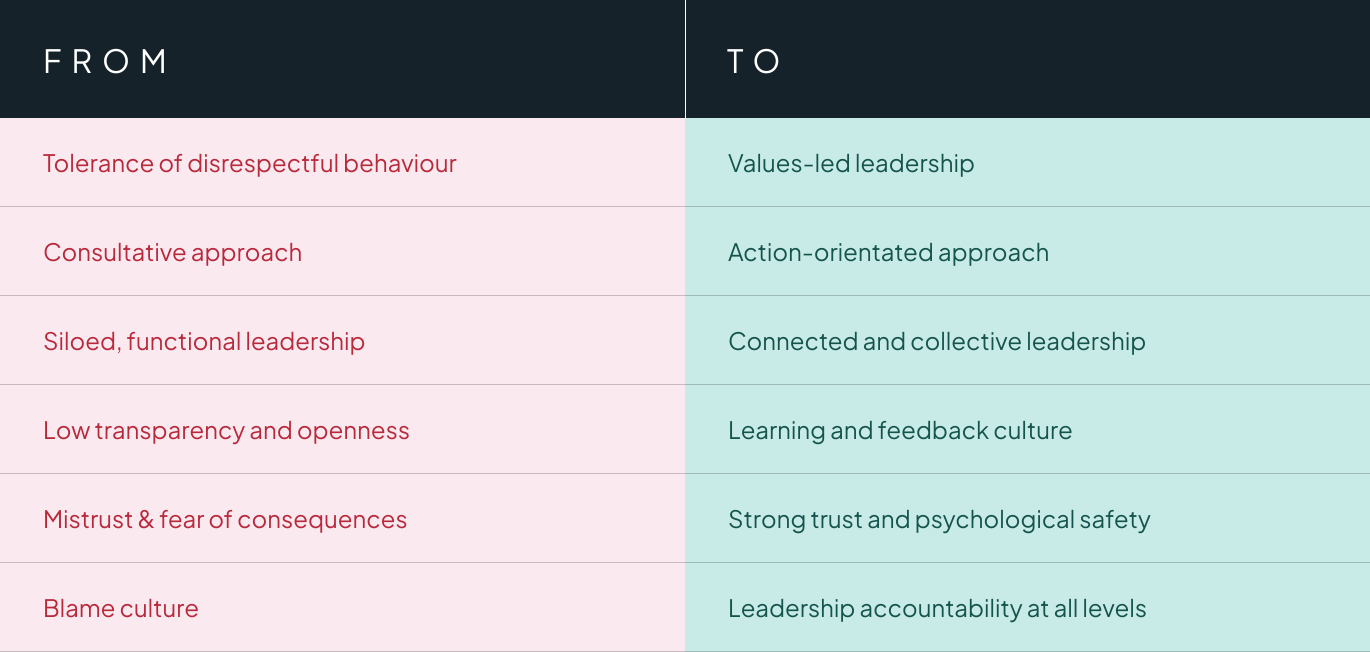
Leadership capability means something different in every organisation. The gaps, the cultural context, the specific behaviours that need to shift, none of that can be assumed in advance. It must be surfaced, agreed, and owned before a single workshop is designed.
A strong diagnostic does two things most miss. It looks outward as well as in. The internal picture — people surveys, 360s, focus groups — tells you how leadership is felt inside the organisation. An outside-in view tells you how it lands with the people leadership exists to serve: partners, customers, suppliers and stakeholders. Triangulating the two surfaces the gap between how leadership sees itself and how it shows up in the world, which is often where the real opportunity sits.
It also looks forward, not just at today’s gaps. A diagnostic can only measure what already exists — and some of the capabilities that will matter most tomorrow are barely present today, so they won’t surface in the data at all. Those have to be defined deliberately, read off your vision and strategy rather than discovered in a survey.
What is the Leadership Ripple, and why does it matter?
Five rings, one connected journey, from leading yourself to building the future.
Once the diagnostic picture is clear, the question is what to build. At dragonfish, our answer is the Leadership Ripple: a five-stage development journey that moves outward from the individual leader to the teams they lead, the systems they operate in, the challenges they need to face, and the future they are responsible for building.
“What leaders say and do every day has a ripple of impact. It shapes how people feel at work, how decisions are made, and how everyone works together across boundaries.”
Each ring in the Ripple is a distinct capability and a distinct development challenge. Each one builds on the last. Together, they describe what future-ready leadership is about, and what it demands.
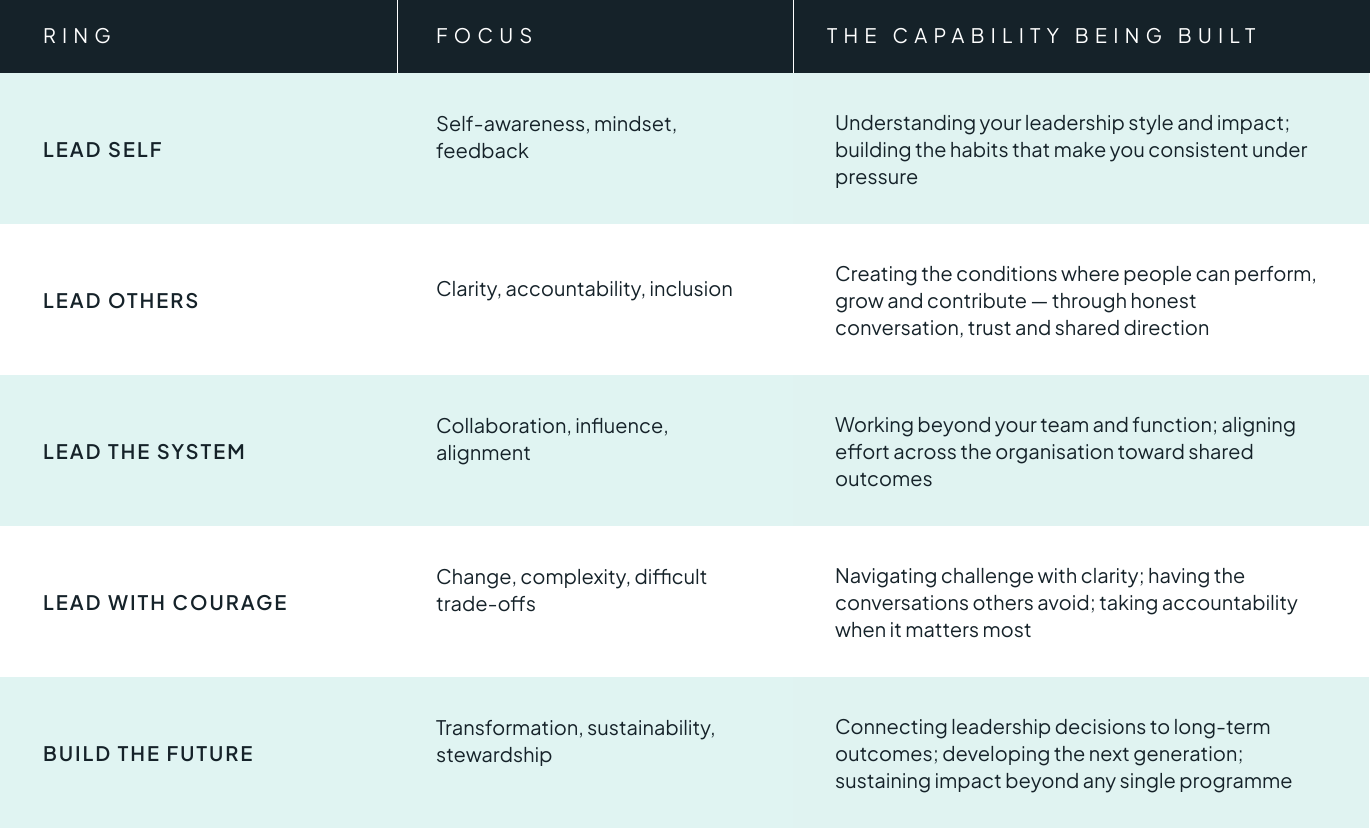
Most leadership development programmes focus almost entirely on the first ring. They build self-awareness, give leaders better tools, help them understand their style. All of this matters, but this base is insufficient on its own.
The organisations with the strongest leadership cultures are the ones that build capability across all five rings and connect them deliberately. Where leading self informs leading others. Where leading others shapes how people show up across the system. Where leading the system creates the conditions for courage. And where courage, sustained over time, builds something that outlasts any individual leader.
That’s what a leadership development programme built around the Leadership Ripple does. And it’s what separates it from many of the leadership and management development interventions on the market.
What does future-ready leadership require, and how do you develop it?
First, what the future demands. Then the framework for building it, ring by ring.
Across every sector, the biggest shift in leadership norms is the same: from “command and control” to “coach and empower”. The leaders who thrive on that frontier share a recognisable set of capabilities.
Foresight — reading what’s coming, not just reacting to what’s arrived.
Adaptability — treating change as the default operating rhythm rather than a disruption to recover from. The discipline of always learning, staying curious and humble when the answers keep moving. Resilience built collectively rather than demanded of individuals.
And empathy — the uniquely human skill that becomes more valuable, not less, as AI takes on more of the technical load.
As we noted in the diagnostic, many of these won’t show up in the data, because organisations don’t fully need them yet. They must be defined deliberately, from your vision and strategy. And none of them is a fixed personality trait. Leaders who can hold uncertainty without flinching, push decisions closer to the work, and stay curious in the face of disruption they don’t yet fully understand are made, not born. All of it is learnable, which is exactly why it belongs in a development programme.
That’s the ‘what’. The Ripple is the ‘how’. It’s worth unpacking each ring, because the capability being built at each stage is specific, and the gap between what organisations invest in and what they really need is often significant.
Lead Self is the foundation. Leaders who don’t understand their own style, their impact on others, or their default behaviours under pressure are limited in everything else they do. The central question is: what kind of leader am I, and what kind of leader do I need to be?
Lead Others is where individual capability translates into team performance. The key competencies here are clarity of direction, accountability without blame, honest conversation, building trust, and creating the psychological safety that allows people to do their best work. These aren’t soft skills. They’re the primary mechanism through which culture is experienced by employees every day. Our Cracking the Culture Code research is unambiguous on this: the scores that most strongly drive high performance are about what a line manager does every day, whether they motivate people around the values, connect the vision to individual work, and recognise the behaviours that matter. All people leaders need to be culture leaders. Not just the top team.
Lead the System is where most leadership development programmes fall shortest. Individual managers can be excellent, and the organisation can still be siloed, slow and misaligned. This ring requires a specific shift in mindset: from leading content to leading context. The expert in the room gives way to the leader who creates conditions for others, stepping out of functional authority and into organisational leadership. That means working across boundaries, influencing without authority, thinking about outcomes rather than functions, and building the connections that allow the whole to be greater than the sum of its parts.
Lead with Courage addresses the capability that leaders most often say they need and organisations least often develop: the ability to navigate complexity, make difficult trade-offs, have the conversations others avoid, and take accountability when the outcome is uncertain. AI and digital transformation have made this ring more urgent than ever. Leaders are being asked to bring their people through disruption they themselves don’t fully understand yet, which requires a different kind of confidence. Not the confidence of the expert, but the confidence of someone who can hold uncertainty, stay curious, and keep people moving forward. That’s a learnable skill. Courage in leadership isn’t a personality trait. It’s built through practice, peer challenge, and the psychological safety to try.
Build the Future is the ring that sustains everything else. It asks leaders to think beyond their immediate role and horizon, to connect their decisions to long-term outcomes, to develop the leaders coming behind them, and to take a stewardship approach to the organisation they are shaping.
The capability gap most organisations underinvest in
In our experience, the biggest disconnect in most organisations isn’t between the frontline and senior leadership, it’s between the executive team and the layer directly below them. Senior leaders often have a clear picture of the direction; the next layer doesn’t fully understand it, doesn’t feel trusted to act on it, or hasn’t been developed to lead at a system level rather than a functional one. Closing that gap is one of the highest-leverage investments an organisation can make.
What makes organisational coaching so powerful in the context of culture change?
Our approach is a distinctive take on organisational coaching; shared goals, not just personal ones.
Coaching is one of the most effective tools for leadership development. But the way most organisations deploy it limits its impact.
Traditional executive coaching focuses on the individual: their goals, their development, their specific challenges. That has real value. But it also creates a ceiling. If every leader is developing against their own personal goals with no shared organisational focus, there’s no guarantee that the coaching is building the collective capability the organisation needs.
Our approach is a distinctive take on organisational coaching, one that aligns all leaders to a shared set of goals and cultural values, not just personal ones. Every leader receives coaching, either 1:1 or in groups, but all coachees are working toward the same organisational objectives. Insights from coaching conversations are shared and connected across the cohort. The result is collective progress, not just individual development.
In practice
Working with a 230-year-old expert public sector organisation on the leadership programme behind a major transformation, we anchored all senior-leader coaching to three shared organisational goals: inspire people around a long-term vision and their own part in it; build the capability and pride to role-model a new set of leadership principles, strengthening trust across the leadership community; and unite teams around customers, putting customer-centricity at the heart of everyday decisions.
Every leader was coached in the context of their own role and challenges, but the shared goals created a common language and direction across the whole leadership community. Coaching was paired with Insights profiling and 360 feedback, so personal self-awareness and collective ambition moved together. The result was leadership development that felt personally relevant and was simultaneously driving systemic change.
Coaching also plays a critical role in sustaining development over time. A leadership programme isn’t an event; it’s a journey and an experience. Insight leads to action. Action generates new challenges. New challenges need space for reflection and course-correction. That loop is what coaching enables.
Why is self-awareness such a critical leadership and management capability today?
Leaders who know themselves well lead others more effectively. The insight must go somewhere.
Self-awareness is one of the most cited leadership qualities. It’s also one of the least developed in practice. The reason is that most organisations treat it as a personality trait rather than a discipline.
The leaders we work with who demonstrate the strongest self-awareness aren’t those with naturally high emotional intelligence. They’re the ones who have built habits: asking for feedback regularly, reflecting on the gap between their intent and their impact, being honest about their default behaviours under pressure.
Profiling tools, whether Insights Discovery, Hogan, or others, can provide a useful lens. They give leaders a shared language for understanding their own style and the styles of those around them. But profiling is a starting point, not an endpoint. The real work is what leaders do with that insight: how they adjust their approach, how they build on their strengths, how they develop the capabilities that don’t come naturally.
“Leaders who know themselves well lead others more effectively. The insight must go somewhere.”
The most important self-awareness finding we see in practice is this: leaders are often unaware of the gap between how they experience their own leadership and how it is experienced by the people around them. In most organisations, that gap is largest not between the frontline and the top, but between the executive team and the layer of leaders directly below them. The senior team thinks the direction is clear. The next layer isn’t sure, isn’t confident, and isn’t behaving accordingly.
Closing that gap, between intent and impact, is where real behaviour change begins. It requires honest data, honest conversations, and a genuine willingness to hear difficult things.
What does the psychology of leadership behaviour change tell us?
Insight alone isn’t enough. You need motivation and opportunity too.
Understanding what needs to change is necessary but not sufficient. The harder question is how leadership behaviour changes, and what makes the difference between a development programme that shifts something and one that produces nothing but better intentions.
Behaviour change requires three things to be present simultaneously: insight (understanding the problem), motivation (genuinely wanting to change), and opportunity (the conditions that make new behaviour possible). Most leadership development programmes focus on the first. Fewer address the second. Fewer still build the third.
Motivation is rarely the problem. Most leaders, given honest feedback and space to reflect, do want to lead better. What undermines that motivation is the absence of safety, the fear that admitting a weakness or trying something new will be used against them. Psychological safety at the leadership team level is therefore not a nice-to-have. It’s a prerequisite for genuine behaviour change.
Opportunity is created by the environment. If a leader returns from a development programme to a culture that doesn’t value transparency, a line manager who doesn’t model learning, or a team structure that rewards individual performance over collective working, the new behaviours will be extinguished quickly. Leadership development that doesn’t also work on the system around the leader will always underdeliver.
This is another reason why the diagnostic matters so much. The point isn’t just to understand what leaders need to develop. It’s to understand what the organisation needs to change to make that development land.
Why is resilience an organisational capability, not just a personal one?
Resilience isn’t built in a crisis. It’s built in the work that happens before one.
Resilience has become one of the most overused words in leadership development. It’s often framed as a personal attribute, something some leaders have and others need to develop. The focus tends to be on helping individuals cope better, bounce back faster, manage their wellbeing.
That framing isn’t wrong. But it’s too narrow. The most resilient leadership cultures we’ve worked with aren’t the ones where every individual has strong personal coping mechanisms. They’re the ones where leadership teams have a shared sense of purpose, a genuine commitment to each other, and a collective willingness to be honest about challenges before they become crises.
Human resilience, at its deepest, comes from having something to stand for, something to fight for, and someone to fight alongside. That’s as true for leadership teams as it is for individuals. The goal isn’t to help leaders cope. It’s to build the shared foundation that means coping is rarely necessary.
In practice
We worked with a world-renowned hospitality organisation on a leadership development programme that began before a period of significant external disruption. Twenty-seven leaders participated in work that built shared vision, honest conversation habits, and collective accountability long before the pressure came.
When the disruption hit, the leadership team held together in a way that surprised even themselves. The resilience wasn’t a product of individual fortitude. It was a product of the shared journey they’d been on, the conversations they’d had, the trust they’d built, the purpose they’d connected to. They were still winning awards in conditions that broke comparable organisations.
The lesson: resilience isn’t built in a crisis. It’s built in the work that happens before one.
Building resilience through leadership development means investing in collective capability: shared values that leaders live and breathe, feedback cultures that surface problems early, and the psychological safety that allows people to raise concerns before they escalate. These aren’t soft objectives. They’re among the most commercially significant things a leadership team can develop.
What does a high-quality leadership development programme look like and deliver?
Five characteristics separate the programmes that shift something from those that don’t.
The best leadership development programmes we have built share five characteristics. Each one is a deliberate design choice. Each one is something that most off-the-shelf programmes miss.
They are built from the diagnostic, not from a catalogue. The content, sequencing and emphasis reflects the specific shifts this organisation needs to make, not a generic leadership skills curriculum, but a bespoke journey built around the shift map that the data revealed.
They work across the full Ripple. Self-awareness and personal development are the foundation. But the programme also builds the capability to lead others, to lead the system, to lead with courage, and to build the future. All five rings. Connected.
They use peer learning deliberately. The most powerful development in any leadership programme doesn’t come from the facilitator. It comes from leaders sharing honestly with each other about what’s working and what isn’t. Peer learning pods, small groups working on live challenges between sessions, are one of the highest-impact elements of any programme we design.
They connect coaching to organisational goals. Individual coaching sessions are grounded in shared direction, not just personal development plans. Line managers are part of the contracting process. The coaching is visible to the organisation, not conducted behind closed doors.
They sustain momentum beyond the programme itself. The most common failure mode of leadership development is that it ends. The formal programme concludes, the cohort disperses, and within six months the habits and insights have faded. The strongest programmes build ongoing community, continued access to learning, and a connection to real work that keeps development alive.
“Leadership development isn’t an event. It’s a journey. The organisations that build great leaders treat it that way.”
How can we measure capability and track its development over time?
Start with the diagnostic. The measurement framework flows from there.
Measurement is where many leadership development programmes struggle. The outputs are easy to count. Sessions delivered, leaders trained, 360 scores. The outcomes, shifts in culture, improvements in team performance, stronger organisational alignment, are harder to attribute and slower to emerge.
The measurement framework should flow directly from the diagnostic. If you started by defining the specific shifts your leaders need to make, measurement becomes a question of tracking whether those shifts are happening, using the same data sources, at different points in time.
If a leadership survey told you that fewer than half of your leaders were seen to be actively role-modelling values at the start of the programme, you want to know what that figure looks like 12 months later. If your employee experience data showed that trust in senior leadership was fragile, you want to track whether it’s shifted. The diagnostic creates the baseline. The programme creates the conditions for change. The measurement tells you whether the change is real.
At an individual level, a combination of 360-degree feedback, behavioural interviews, and capability assessments, aligned to your leadership framework, gives leaders a precise picture of where they are and what they need to develop next. The key is that measurement is integrated with the wider culture and performance work, not treated as a standalone HR exercise.
Done well, measurement closes the loop. It connects the development investment to business outcomes. It tells leaders and organisations what’s working, what isn’t, and what to prioritise next. That’s the difference between leadership development as a cost and leadership development as a compounding advantage.
See also:
Pillar 1: Organisational Culture Transformation →
Pillar 2: The Alignment Advantage →
If you’re building leadership capability for the current moment or want to understand where your development investment would have the greatest impact, start with the diagnostic.
Take the free Lumin assessment → | Talk to us →
dragonfish is a pioneering culture and performance consultancy. We build future-ready leadership and management capability through the Leadership Ripple, diagnosing the shifts your organisation needs to make, then building a connected development journey across all five rings.
Explore our leadership development services →


