


Growth. Margin. Productivity. Customer Loyalty. People. AI.
Every organisation is under pressure to deliver more. But ambitious targets, new technology and talented people do not automatically translate into stronger results.

Businesses are investing in technology, transformation, talent and customer experience. Every function has a strategy. Every leader has a scorecard. Yet the results do not always add up.
Performance does not improve simply because every part of the business is trying harder.
It improves when those parts work better together.
When your business, brand, customer and culture strategies are all pulling in the same direction — and when leaders and teams are aligned.
Investment, ambition and capability are essential. But when leadership, priorities and ways of working are disconnected, potential does not always translate into lasting performance.
66% of C-suite leaders say moving beyond functional boundaries is very or extremely important; just 7% report making great progress.
Organisations with strong organisational health are three times more likely to outperform those with poor organisational health.
56% of CEOs report no significant financial benefit from AI to date.
The opportunity is not simply to invest more. It is to remove the organisational friction that prevents existing investment, talent and capability from delivering stronger results.
Three common traps can quietly undermine enterprise performance — even when individual teams appear to be delivering.
Everyone hits their targets. The business misses its ambition.
Functional targets drive local success while competing incentives, handoffs and decisions undermine collective outcomes.
Spending increases. The return does not.
AI, technology, transformation and capability investments generate activity without changing the work needed to realise value.
People are busier. Output is not improving.
Slow decisions, duplicated effort, rework and unnecessary complexity consume the capacity leaders are trying to create.
Most organisations don’t lose performance in one big failure. They lose it gradually, as competing priorities, slow decisions and disconnected teams wear down every gain. The model shows how.
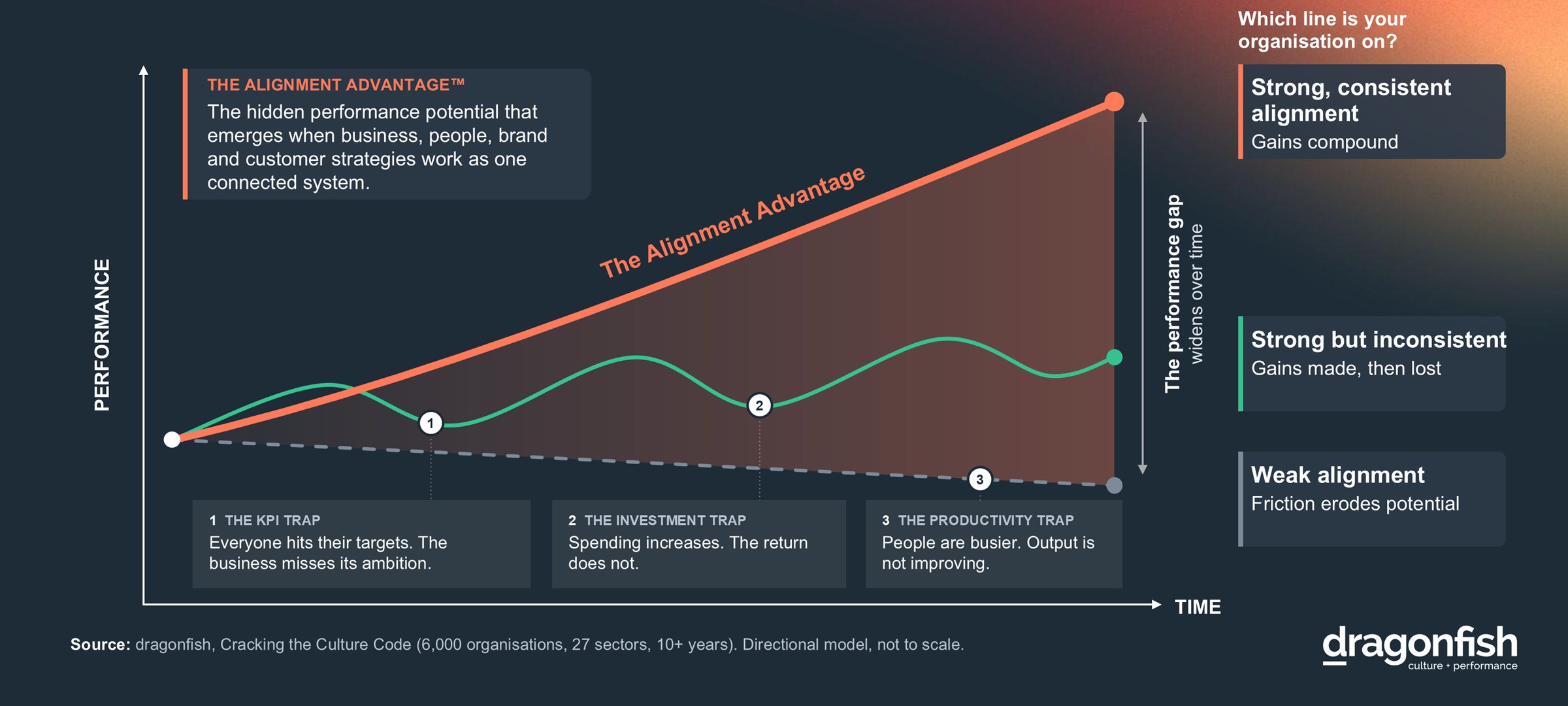
The difference in consistency of cultural alignment between high-performing and low-performing organisations. High performers don’t just score better on people, brand and customer dimensions, they score more consistently across all three.
That consistency is the hallmark of the Alignment Advantage™.
Performance is the outcome. Alignment is what makes the system work.
Dragonfish’s Alignment Advantage™ connects strategy, leadership, systems and ways of working with the experiences of people, customers and the brand — helping individual improvements add up to collective performance.
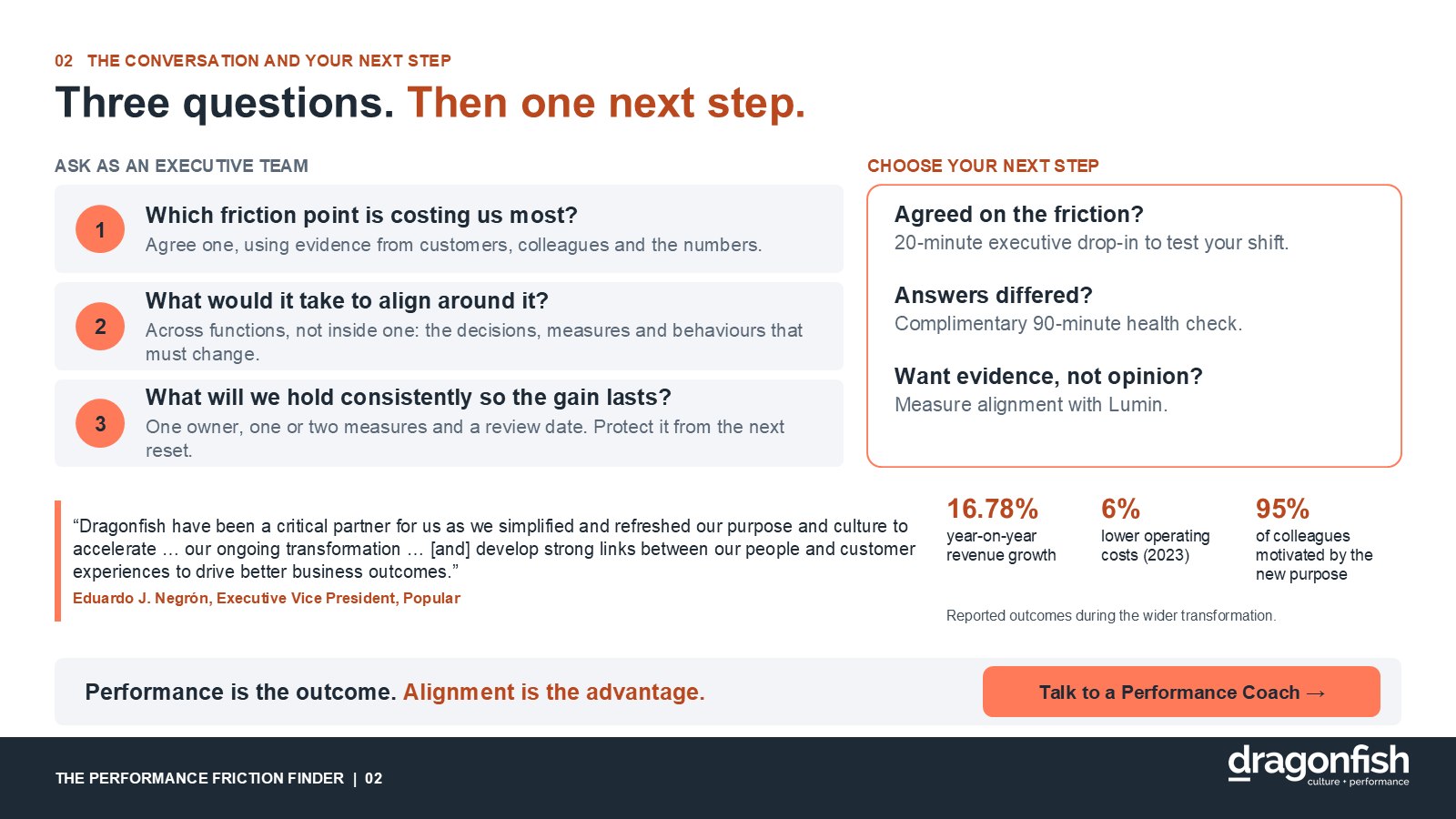
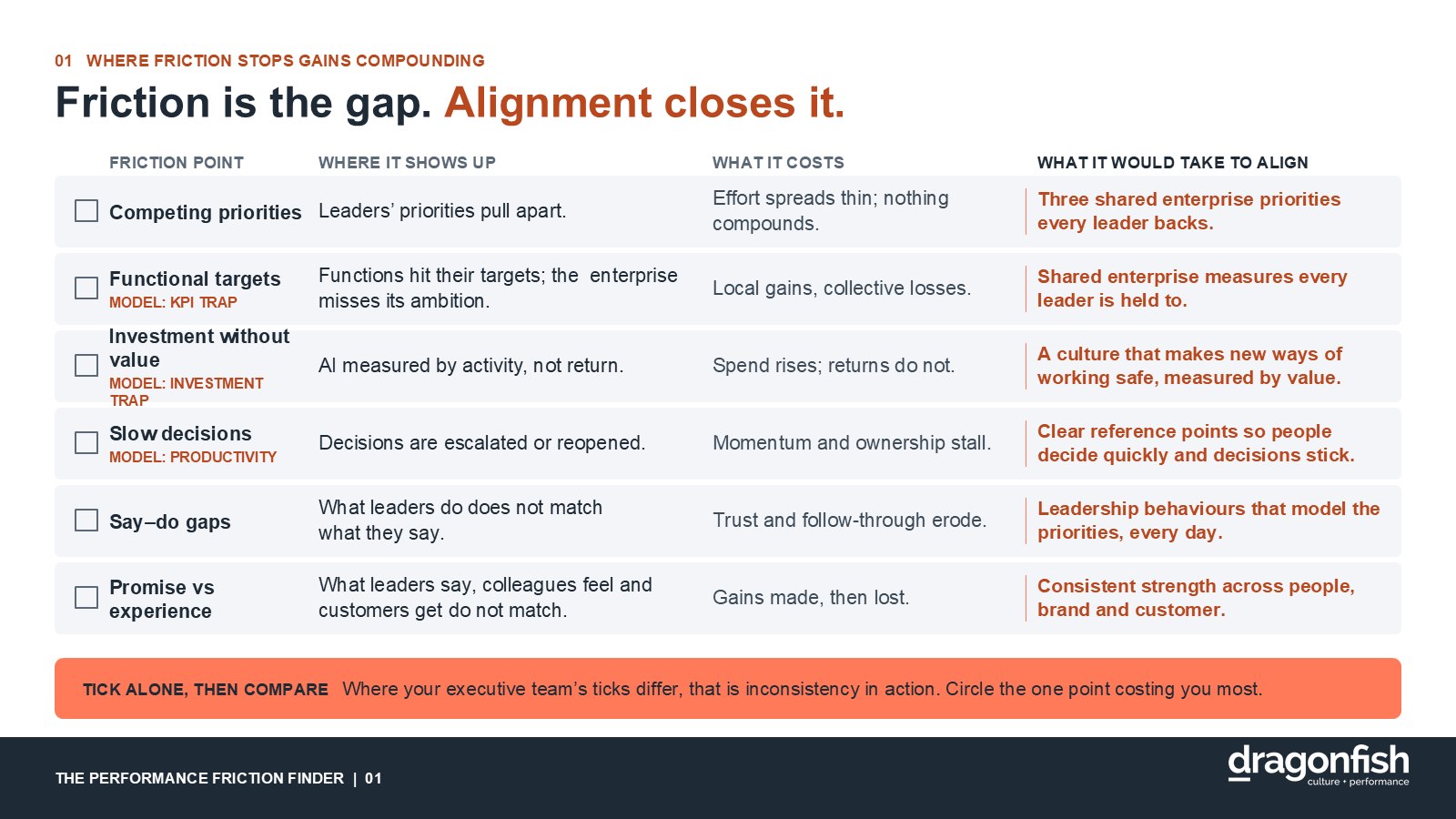
Six friction points. Three questions. One leadership conversation worth having.
The Performance Gap Friction Finder helps your team find where friction is holding results back, what it would take to align and the key questions to ask.

A 130-year-old bank facing growing competition needed to move faster, strengthen customer focus and modernise how it worked.
Dragonfish helped connect purpose and culture to strengthen the transformation agenda, aligning leaders, strengthening accountability and embedding new performance-focused ways of working.
Our Performance Coaches help leaders explore where growth, margin, productivity, customer outcomes or technology returns are being constrained — and where to focus improvement across leadership, culture, teams and ways of working.
A practical conversation, not a sales pitch.


